
1. Why Is Edge Finishing Important in Automotive Manufacturing?
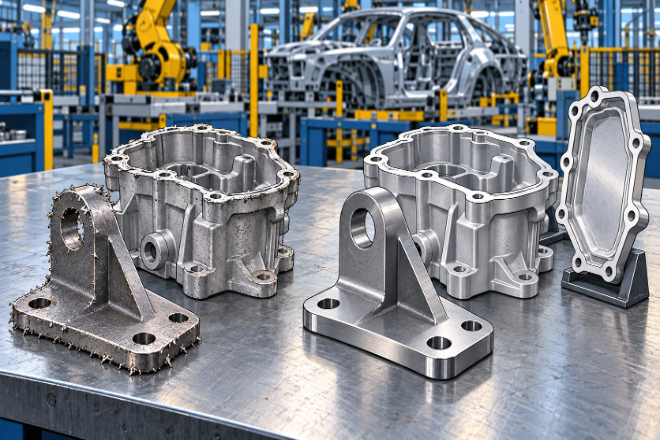
自動車 manufacturing involves many processes, including casting, stamping, molding, cutting, and CNC machining.
These processes can leave behind burrs, sharp edges, excess material, or uneven contours.
Although these defects may look minor, they can create real problems on the production line.
For example, a burr around a machined hole may affect how a bolt or another component fits. Rough edges on an aluminum housing may interfere with assembly.
Excess material on a molded plastic part may affect its appearance or prevent two parts from fitting together properly.
Edge finishing helps address these issues before components move to the next stage.
For automotive manufacturers, good edge finishing supports several important goals:
Accurate assembly: Parts fit together as designed.
Consistent quality: Components meet the same finishing requirements across production batches.
Less rework: Fewer parts need extra manual correction.
Safer handling: Sharp edges are removed where required.
Reliable downstream processes: Clean edges help prepare parts for assembly, coating, sealing, or inspection.
ここは 超硬トリミングツール become useful. Their cutting edges can remove small amounts of unwanted material with good control, helping manufacturers meet finishing requirements without removing more material than necessary.
However, not every automotive part needs the same tool. The right choice depends on the workpiece material, edge shape, size tolerance, and production method.
2. How Are Carbide Trimming Tools Used on Engine and Transmission Components?
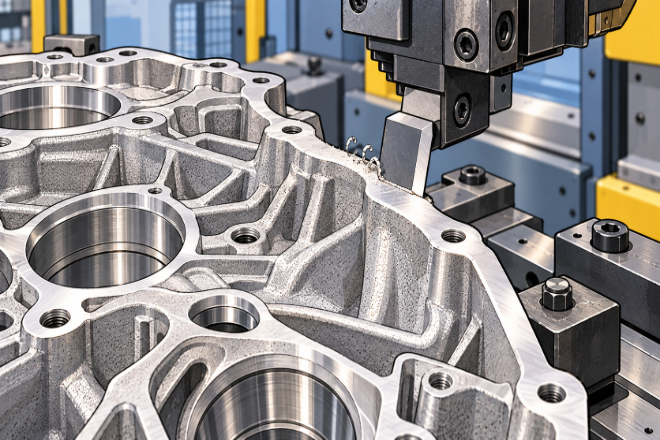
Engine and transmission components often contain complex shapes, narrow openings, and machined edges.
After casting or CNC machining, some areas may still have small burrs or unwanted material that needs to be removed.
Carbide trimming tools can help finish these areas without requiring a large cutting tool for every small correction.
一般的な用途としては以下のようなものがあります。
Engine housings: Removing burrs around machined openings and edges.
Transmission housings: Cleaning selected edges and small features after machining.
Aluminum components: Trimming unwanted material from lightweight structural parts.
Mounting brackets: Removing sharp edges that may affect assembly.
Precision metal parts: Finishing small contours and difficult-to-reach areas.
Aluminum components deserve particular attention. They are widely used in vehicle manufacturing because they offer a useful balance of low weight and strength.
However, machining aluminum can leave burrs around holes, slots, and edges.
A suitable carbide trimming tool can remove these defects while helping preserve the part’s required shape and dimensions.
Tool geometry matters here. A small-diameter tool may reach a narrow opening, while a different cutting profile may work better along a wider edge.
The correct choice depends on the part design and the amount of material that needs to be removed.
One important point: trimming tools should not replace precision machining when a feature requires a defined diameter or tight dimensional tolerance. Their main role is controlled edge removal and finishing.
3. Can Carbide Trimming Tools Improve Automotive Plastic Part Quality?
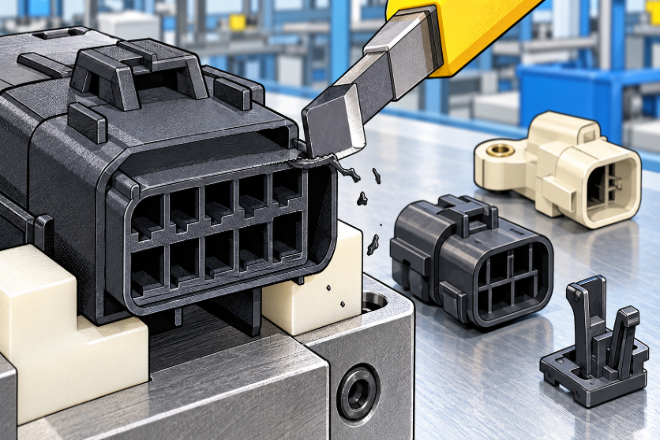
Not every automotive component is made from metal. Modern vehicles also use plastic parts in interior panels, electrical connectors, housings, clips, and other assemblies.
Injection molding can leave thin excess material, often called flash, around parting lines or openings.
Cutting and other finishing operations can also leave rough edges that need attention.
Carbide trimming tools can help remove this excess material when the tool design suits the plastic and the part geometry.
For example, a molded connector housing may have a small amount of flash around an opening.
If the flash remains, it may interfere with assembly or affect the appearance of the finished part.
A suitable trimming tool can clean the edge while limiting damage to nearby features.
However, plastics require careful handling. Too much heat or cutting pressure may soften the material, leave marks, or change the shape of a thin wall.
Manufacturers should pay attention to:
Cutting edge design: The geometry should suit the type of plastic being processed.
Cutting speed: Excessive heat can damage some plastic materials.
Part support: Thin walls and small features need stable support.
Chip removal: Plastic chips should not build up around the cutting area.
Edge inspection: The finished part should be checked for flash, scratches, and shape changes.
For high-volume automotive production, these details matter. A fast trimming operation is only useful if the part still meets its quality requirements.
4. How Do Carbide Trimming Tools Support Automated Automotive Production?
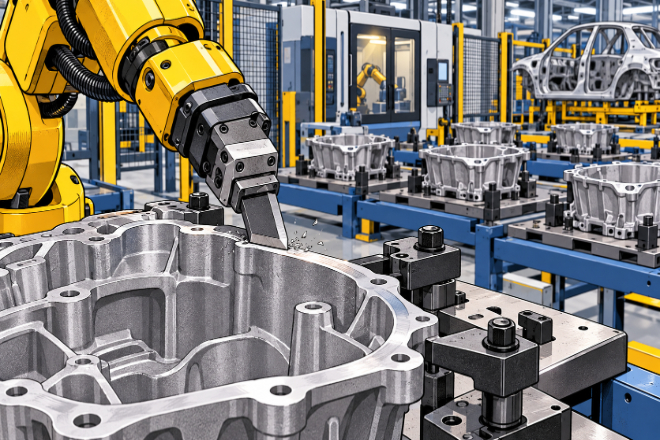
自動車 factories often process large numbers of similar components.
Manual finishing may work for prototypes or occasional repairs, but it can become difficult to control when production volumes increase.
Carbide trimming tools can be used in suitable CNC machines, robotic systems, and other rotary machining setups.
When the tool, machine, and part are properly matched, automated finishing can follow a repeatable path across many components.
This offers several practical benefits.
More Consistent Finishing
A programmed path helps control where the tool contacts the workpiece.
This can reduce differences between parts caused by changes in manual pressure or tool angle.
Less Manual Work
Automated trimming can reduce the amount of hand finishing needed after machining or molding.
Workers can then focus on setup, inspection, and process control.
Better Production Planning
When cycle time and tool life are predictable, production teams can plan output and tool replacement more effectively.
Easier Process Monitoring
Manufacturers can track cycle time, tool wear, and finished-part quality to identify problems before they affect a large batch.
Automation does not guarantee better results by itself.
Poor tool holding, vibration, incorrect cutting settings, or an unstable fixture can still cause defects. The process needs proper testing before it is used for full production.
5. How Do Carbide Trimming Tools Affect Automotive Production Costs?
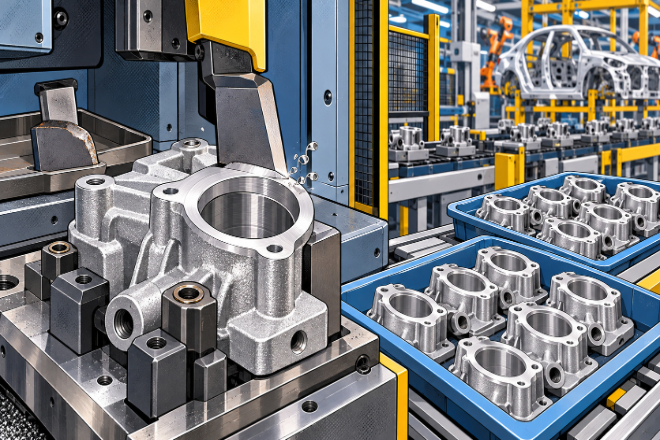
The purchase price is only one part of the cost of a trimming tool. Manufacturers also need to consider how the tool affects production time, quality, and maintenance.
A tool with a low initial price may become expensive if it wears quickly or leaves edges that require extra work.
By contrast, a well-matched carbide trimming tool may help reduce tool changes and improve finishing consistency.
The main cost factors include:
Tool replacement: How often does the tool need to be changed?
Machine downtime: How much production time is lost during replacement or adjustment?
Manual finishing: How much extra labor is needed after machining?
Rejected parts: Does the process create damaged edges or parts outside the required limits?
Inspection time: Are extra checks needed because finishing results vary?
Production output: How many acceptable parts can be completed during a shift?
A useful comparison should measure the full process rather than only the cutting time for one part.
For example, one tool may finish a component quickly but need frequent replacement.
Another may take slightly longer per part but last longer and produce fewer defects. The better choice depends on the total cost of producing acceptable components.
For automotive manufacturers working with large batches, even small improvements in tool life or rework rates can matter when they are repeated across many production cycles.
 English
 Español
 简体中文
 Français
 日本語
 한국어
 العربية
 Tiếng Việt