
1. Why Are Carbide Burrs Useful After Tube Cutting?
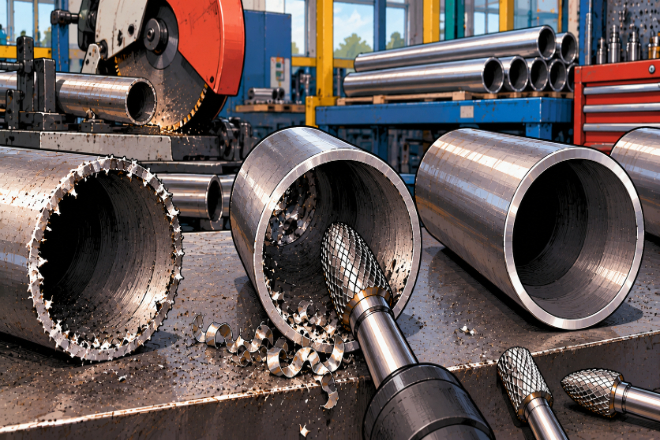
Tube fabrication often starts with cutting.
A saw, laser, or another cutting system separates the tube to the required length. The cut may be fast, but the edge is not always ready for welding, assembly, coating, or handling.
Small burrs can remain around the inside or outside diameter. There may also be a sharp edge or a local high spot.
Leaving these features in place can create problems later. A sharp burr can make manual handling less safe. It can interfere with assembly. It may also affect how one tube sits against another component.
一个 tungsten carbide burr for tube fabrication can quickly remove these unwanted areas.
Unlike an abrasive tool that mainly wears material away, a carbide burr uses defined cutting teeth. This makes it effective for deburring, levelling, surface work, and other local metal-removal jobs.
The small cutting head is particularly useful on tubes. The outside edge is easy enough to reach. The inside edge is another story.
A grinding disc that looks perfectly reasonable beside a flat steel plate suddenly looks enormous when it needs to enter a small tube.
A carbide burr can reach inside the opening and work around the inner edge with much better access. The operator can also remove material only where it is needed.
That control matters with thin-wall tubing. There is usually no benefit in grinding away good material just to remove one small burr.
Of course, carbide burrs are not the only way to deburr tubes. High-volume production lines may use dedicated deburring machines or automated systems.
But fabrication rarely produces only perfect, repetitive parts.
There are prototypes, small batches, custom assemblies, rework, unusual angles, and those occasional parts that seem determined to make the production team work harder.
That is where the flexibility of a carbide burr becomes valuable.
2. How Do Carbide Burrs Help With Tube Notching and Fit-Up?
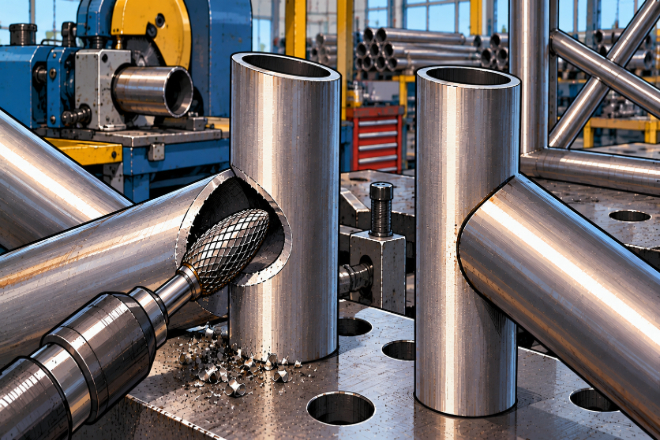
Many fabricated tube structures require one tube to meet another. Think about frames, railings, machinery, vehicle structures, furniture, supports, and welded tube assemblies.
When a round tube meets another round tube, the end often needs a shaped notch.
A tube notcher, laser cutting system, CNC machine, or other process can create the main profile. However, small local corrections may still be needed before welding.
This is a good job for a carbide burr. Imagine two tubes meeting at an angle.
Most of the notch fits correctly, but one small area touches too early. Instead of removing material from the entire notch, the fabricator can use an oval, cylindrical, tree, or flame-shaped burr to correct that local point.
Then the fit is checked again. A little metal comes off. The tubes go back together. Another small correction is made if needed. This is controlled fitting rather than aggressive grinding.
Good fit-up can also make the next operation easier. When the tube surfaces meet as intended, the welder is starting from a more predictable joint.
The burr shape should follow the tube geometry.
A cylindrical burr can handle relatively straight local areas. An oval burr works well on changing curves. Tree and flame shapes are useful when the notch becomes narrower or changes direction.
For deeper access, a long-shank carbide burr may help.
However, extra shank length should only be used when necessary. More overhang can increase vibration and make the cutting head harder to control.
There is also a production lesson here. If nearly every notched tube needs heavy manual correction, the carbide burr is probably not the real solution.
Check the notching process.
Check the fixture.
Check the tube size.
Check the cutting program.
A burr should correct small differences. It should not become a full-time employee repairing a poor upstream process.
3. Where Are Carbide Burrs Used on Holes, Slots, and Tube Edges?
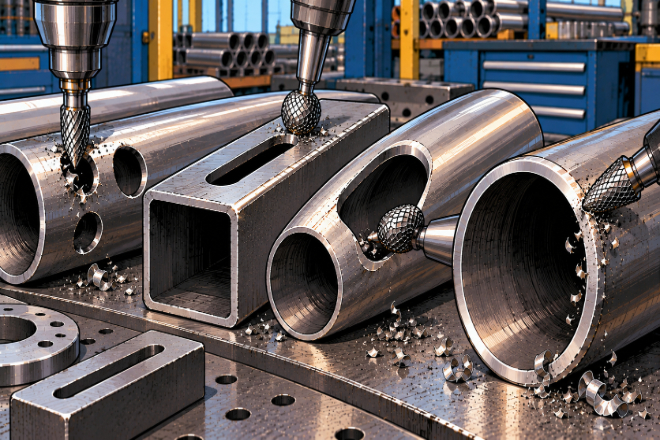
Tubes are rarely left as simple hollow sections.
Fabricated tubes may need holes for bolts, slots for assembly, openings for fittings, access holes, drainage holes, mounting points, or other features.
Creating the hole is one operation. Cleaning it is another.
After drilling or cutting, the opening may contain a sharp burr. A small cone, ball, or cylindrical carbide burr can remove that unwanted material.
硬质合金旋转锉 are also used for cutting out and working around holes, which makes them useful when an opening needs a small local correction.
This does not mean the operator should use a burr to turn every wrong hole into a larger one.
If a hole has a tight dimensional tolerance, proper drilling, reaming, milling, or another controlled machining process should be used.
The burr is better for local finishing and correction. Slots create similar jobs.
A narrow slot can have rough corners or cutting marks that larger finishing tools cannot easily reach. A small carbide burr can enter the feature and clean selected areas.
Tube ends can also require more than basic deburring. Sometimes the sharp corner needs to be broken or rounded. In other cases, the drawing may require a controlled chamfer or radius.
General carbide burrs can handle flexible edge work, while specialized EDGE-cut carbide burrs are available for defined work on edges. These tools can create controlled chamfers or a defined outer radius.
That can be useful for fabricated tube components where the edge condition is part of the product requirement rather than simply a cosmetic choice.
The important thing is to know the target before cutting. “Make it less sharp” and “produce a defined edge profile” are two very different instructions.
The carbide burr needs to match the second sentence, not just the first.
4. How Are Carbide Burrs Used Around Welded Tube Assemblies?
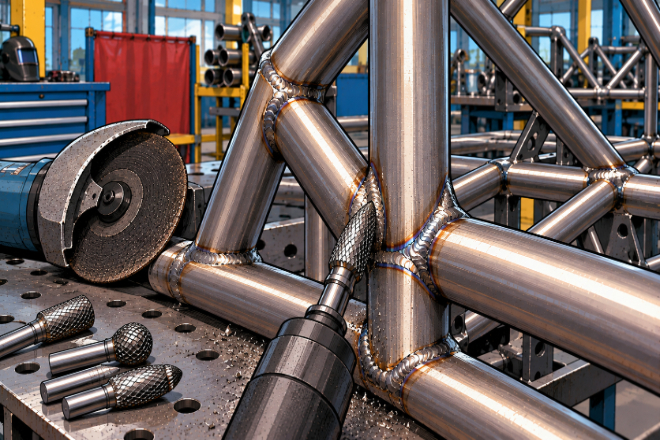
Once the tubes have been cut, notched, drilled, and fitted, many assemblies move to welding.
That creates a new set of local finishing jobs. Carbide burrs are commonly used for work on weld seams, making them useful in fabricated tube structures where controlled weld cleanup is required.
Access is one of their biggest advantages. A large grinder works well on an open surface. Now put the weld between two tubes. Add another support beside it. Move the joint into a corner.
Suddenly the large grinder is much less impressive. A ball, oval, tree, or flame-shaped carbide burr can work around curved weld areas and between closely spaced components.
The tool may be used to remove permitted excess weld metal, blend a repaired area, clean a difficult corner, or prepare a local area for another operation.
However, not every weld should be ground smooth. If a weld already meets the drawing, structural requirement, and inspection standard, unnecessary grinding adds labor and removes material for no useful reason.
The same warning applies to thin-wall tubes. A carbide burr removes metal efficiently. That is exactly why the operator needs control.
Too much pressure or repeated cutting in one small area can remove more material than intended.
Weld repair is another possible application. If an approved repair process calls for local metal removal around a weld defect, a suitable carbide burr can provide access and control.
But the repair procedure should determine how much material is removed and what final geometry is required.
The burr performs the cutting. It does not decide whether the weld is acceptable. For production managers, this distinction helps prevent “finishing” from quietly turning into unnecessary rework.
5. Which Carbide Burr Should You Use for Tube Materials?
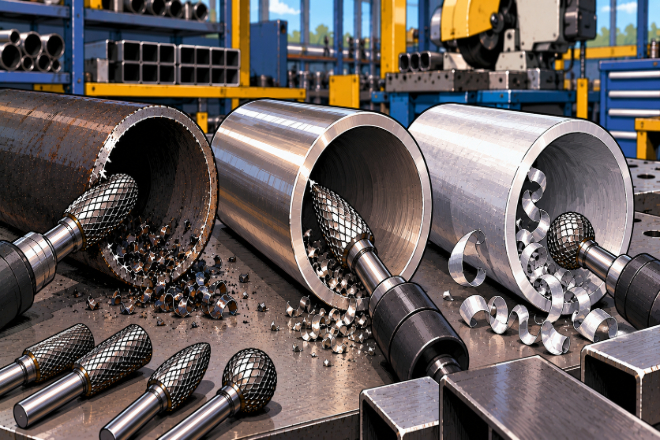
Tube fabrication covers many materials. Carbon steel is common in structural frames, machinery, equipment, and general fabrication.
Stainless steel is widely used where 耐腐蚀性, hygiene, or appearance matters.
Aluminum tubing is popular when lower weight is important. These materials do not cut in the same way.
For steel and cast steel, material-specific carbide burr geometries are available for operations such as deburring, levelling, holes, surface work, and weld seams.
Stainless steel needs a different approach. Stainless-specific burrs are designed to support good chip formation and controlled cutting while limiting unnecessary heat.
PFERD’s INOX burrs, for example, are intended for deburring, holes, surface work, and weld-seam applications on stainless steel.
Aluminum creates another challenge. Because aluminum is soft, chips can stick between tightly spaced teeth.
More open ALU-type cutting geometry gives the chips more room to escape and helps reduce loading.
So the material should be considered before the burr shape. Then match the shape to the job.
6. What Mistakes Make Tube Deburring Slower?
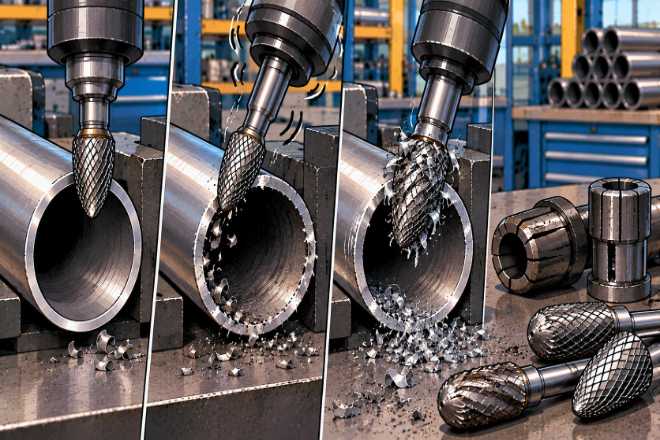
The first mistake is simple: pushing too hard. Carbide is hard and 耐磨, but that does not mean the burr should be forced into the tube.
The cutting teeth should do the work. Heavy pressure can increase vibration and make precise control more difficult. The second problem is incorrect speed.
There is no single rotational speed for every tungsten carbide burr. Burr diameter, cutting geometry, tube material, tool drive, and manufacturer guidance all affect the correct operating range.
Follow the recommended speed for the actual tool. Poor tool setup creates another common problem.
If the collet is worn, the spindle has poor bearings, or the burr is mounted with excessive overhang, vibration can appear.
That vibration is more than annoying. It can leave chatter marks and make the operator less accurate.
Good concentricity helps a carbide burr run more smoothly. This is particularly useful when finishing thin tube edges or working close to surfaces that should remain untouched.
Another mistake is using one burr for every material. A steel burr that works happily all morning may become much less cooperative when pushed into soft aluminum.
If aluminum chips begin packing between the teeth, stop and solve the loading problem rather than pushing harder.
For stainless steel production, tool separation may also be part of the shop’s contamination-control process. If the company keeps carbon-steel tools away from stainless work, carbide burrs should follow the same rule.
Finally, avoid unnecessary finishing. If the tube edge is already acceptable for the next operation, another minute of grinding is not “extra quality.”
It is another minute of production time. Good tube fabrication is not about touching every surface with every tool. It is about doing exactly enough work to produce the required part.
7. How Should Tube Fabricators Evaluate Carbide Burrs?
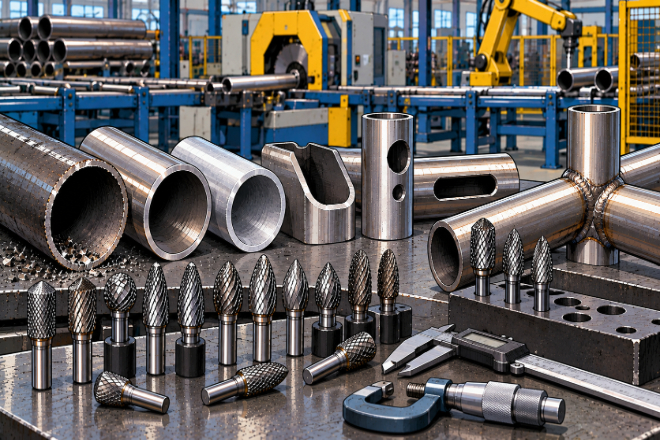
For a fabrication company, tool evaluation should start with the real production process. Do not test a carbide burr only on a convenient flat plate.
Bring out the tubes. Test inside cut tube ends. Try notched joints. Use drilled and laser-cut openings. Work around actual welded assemblies.
Include steel, stainless steel, and aluminum if all three materials are part of regular production. Then measure the things that affect the business.
How quickly does the burr complete the operation?
How easy is it to guide?
Does it chatter?
Does aluminum load the cutting teeth?
How many parts can be completed before performance drops?
Does another finishing tool need to follow it?
Consistency between burrs is also important. A production team does not want one burr to run smoothly and the next one to feel completely different.
Check dimensions, cutting geometry, concentricity, and the head-to-shank construction when comparing suppliers.
Tool inventory deserves attention too. A tube fabrication company may need cylindrical, ball, oval, tree, flame, and cone shapes—but not every possible size of every possible shape.
Look at the company’s most common tube diameters, materials, joints, openings, and welds.
Build the burr selection around those jobs. For repetitive production, carbide burrs can also move beyond manual work.
Current industrial carbide burr systems are compatible not only with straight grinders and flexible shafts but also with robots and machine tools.
That can make automated deburring or finishing worth considering when part geometry and production volume justify it.
The final comparison should be based on cost per acceptable fabricated tube component, not simply price per burr.
Tool cost matters. So do labor time, secondary finishing, rework, tool changes, and production consistency.
A small carbide burr will never be the most expensive item in a tube fabrication shop. Used in the right place, however, it can help some very expensive equipment keep moving.
 English
  Español
  简体中文
简体中文  Français
  日本語
日本語  한국어
한국어  العربية
  Tiếng Việt