
1. Why Is Carbide Burr Selection Important for Automated Deburring?
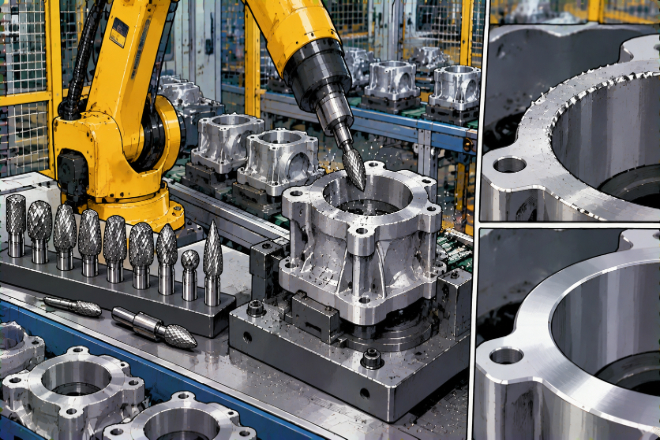
Automated deburring is becoming more common in industries that require stable quality and high production speed.
Factories producing 汽车 parts, 航天 components, hydraulic parts, molds, and industrial equipment often need to remove sharp edges, burrs, and unwanted material after machining.
At first glance, deburring may look like a simple finishing step.
It is not. A small burr left on a component can affect assembly, sealing, movement, or surface quality. At the same time, removing too much material can damage the final part.
This is why the carbide burr used in an automated system matters.
In manual work, an experienced operator can adjust pressure and movement by feeling the tool. Automated systems do not work that way.
The machine follows programmed movements, so the cutting tool must provide stable and predictable performance.
A good carbide burr for automated deburring should offer:
Consistent cutting performance
好的 耐磨性
Stable geometry
Low vibration
Reliable edge quality
Tungsten carbide is commonly selected because it has high 硬度 and can maintain cutting ability during long production cycles.
However, hardness alone is not enough. A burr designed for hand-held grinding may not perform well in a robotic cell.
Automated applications often need different considerations, including tool balance, shank design, cutting pattern, and machine speed.
The wrong burr can create several issues:
Excessive vibration
Uneven edge removal
Short tool life
Increased cycle time
Extra finishing work
For production managers, the goal is not simply removing burrs. The goal is creating a repeatable process.
That means the burr should work together with the robot, spindle, workpiece material, and production requirements.
2. How Do You Match Carbide Burrs with Different Materials?
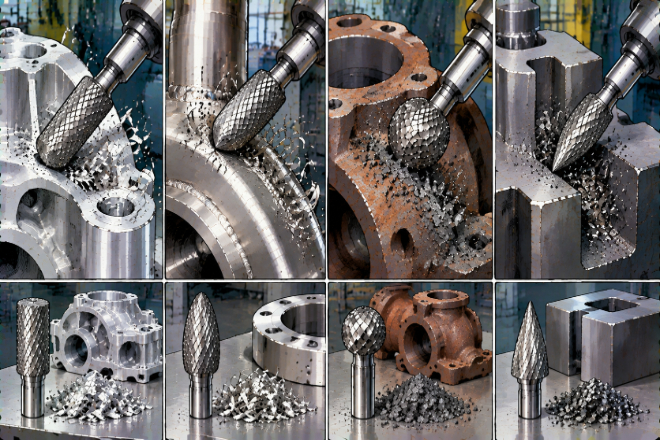
The first step in choosing a carbide burr for automated deburring is understanding the material. Different metals behave differently during cutting.
A burr that works well on aluminum may not perform well on hardened steel. A tool designed for stainless steel may not be the best option for cast iron.
Common materials in automated deburring include:
铝
不锈钢
Carbon steel
铸铁
淬硬钢
钛合金
Aluminum creates a special challenge because chips can stick to the cutting teeth. For aluminum components, open-cut designs are often preferred because they help move chips away and reduce clogging.
Steel and stainless steel usually require stronger cutting edges because the material creates higher cutting resistance.
Cast iron can create abrasive dust and requires a burr with suitable 耐磨性. Aerospace and medical components may involve harder alloys where tool life and surface quality are both important.
A simple selection guide:
3. Which Carbide Burr Shapes Work Best for Robotic Deburring?
Automated deburring systems often work with complex components. A robot may need to remove burrs from:
Machined edges
Internal holes
Corners
Curved surfaces
Casting lines
Weld areas
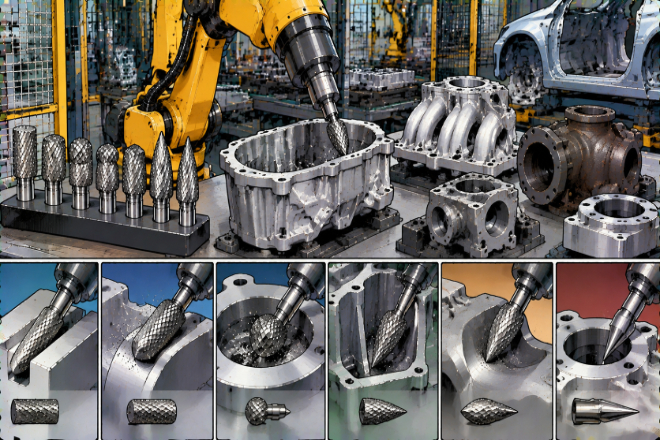
This is why burr shape selection is important. A cylindrical burr is commonly used for straight edges and general surface work.
A cylindrical radius-end burr provides more flexibility because it can follow curved transitions. A ball burr works well for curved areas and internal surfaces.
A tree-shaped burr is useful for narrow sections and corners. A flame-shaped burr can follow changing profiles.
A cone burr can reach angled areas and smaller openings. For automated systems, the shape should match the programmed path.
A robot does not “feel” the part. If the burr shape does not fit the surface, the machine may create uneven contact.
This can lead to:
工具过度磨损
表面光洁度差
Longer cycle times
More programming adjustments
Many manufacturers choose several standard burr shapes rather than forcing one tool to handle every job.
This creates more stable production. The best burr is not always the fastest cutting one.
In automated manufacturing, repeatability often matters more than maximum material removal.
A tool that removes slightly less material but produces the same result every cycle may create more value.
4. How Do Cutting Speed and Machine Setup Affect Burr Performance?
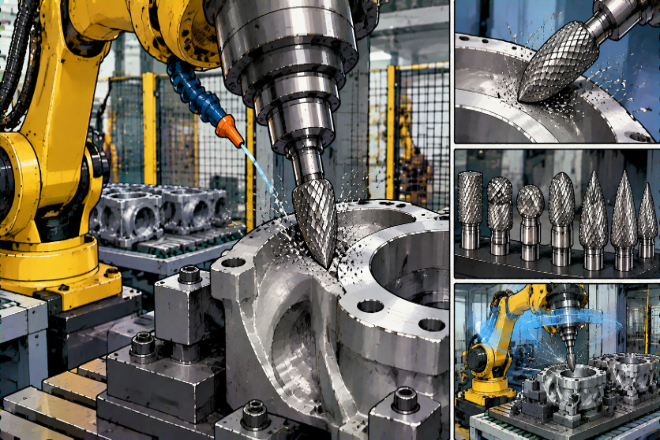
A carbide burr cannot perform independently. The machine setup directly affects the result.
Important factors include:
Spindle speed
进给率
Tool angle
Tool overhang
Workpiece holding
Robot movement
Running a burr at the wrong speed can reduce tool life. Too slow, and the burr may push instead of cut. Too fast, and heat and wear may increase. Tool overhang is another important factor.
A longer tool extension allows access to difficult areas, but too much extension can increase vibration.
This is especially important in robotic applications because vibration can affect both the tool and the programmed path.
Tool balance also matters. High-speed rotation requires good concentricity. An unbalanced tool can create vibration, poor surface quality, and faster spindle wear.
The contact method is also important. The burr should cut the material instead of being forced into it. Too much pressure can damage cutting teeth and create unstable results.
For automated systems, manufacturers should test the complete process:
工具
Spindle
速度
进给率
Robot movement
Part fixture
Changing only the burr without checking the whole system may not solve the problem. Automation is a team sport. The burr, machine, and program need to work together.
5. How Can Companies Improve Automated Deburring Efficiency?
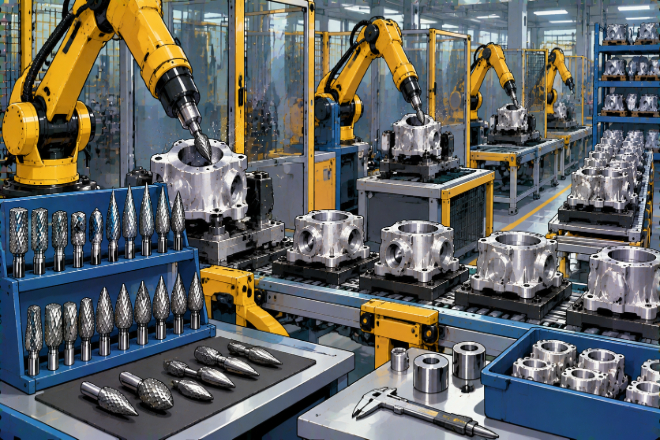
Improving automated deburring is not only about buying a better burr. It is about improving the complete process. The first step is measuring current performance.
Companies should track:
刀具寿命
Cycle time
Edge quality
Rework rate
Production downtime
These numbers show where improvements are needed.
For example, a burr with a lower purchase price may create more costs if it needs frequent replacement.
A longer-lasting burr may reduce tool changes and keep production running. The cutting pattern also influences efficiency.
Different burr cuts provide different balances between material removal and surface quality. A roughing cut may remove material quickly.
A fine cut may create a smoother edge. Automated systems often benefit from predictable cutting rather than maximum aggressiveness.
Maintenance also matters. Robotic deburring equipment should be checked regularly. Worn holders, damaged collets, or spindle problems can reduce performance even when the carbide burr is high quality.
Companies should also create standard tool rules. For example:
Which burr is used for aluminum parts?
Which burr is used for steel?
When should the tool be replaced?
What edge quality is acceptable?
Clear standards reduce variation between production batches. The final goal is simple: Make every part leave the cell with the same acceptable edge quality.
6. How Should Manufacturers Choose Carbide Burr Suppliers for Automation?
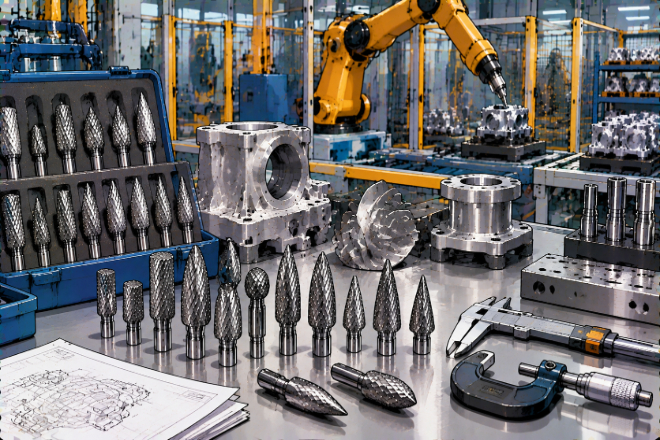
Choosing the right supplier is important because automated production requires consistency.
A good supplier should provide:
Stable burr quality
尺寸精确
Material-specific options
技术支援
Reliable delivery
Automated systems depend on repeatability. If one batch of burrs performs differently from another, production settings may need constant adjustment.
That creates hidden costs. Manufacturers should evaluate suppliers based on actual production results.
Important questions include:
Does the burr maintain cutting performance?
Is the tool geometry consistent?
Does the supplier understand automated applications?
Can they provide different cuts and shapes?
Customization can also be valuable. Some automated deburring applications involve special components where standard burrs are not ideal.
A supplier that can support custom sizes, coatings, or cutting designs may provide better long-term value. For decision-makers, the cheapest burr is rarely the final answer.
The better question is: “Which burr gives the lowest cost per finished component?” That includes tool life, machine uptime, labor savings, and product quality.
 English
  Español
  简体中文
简体中文  Français
  日本語
日本語  한국어
한국어  العربية
  Tiếng Việt