
1. Start With the Material You Need to Cut
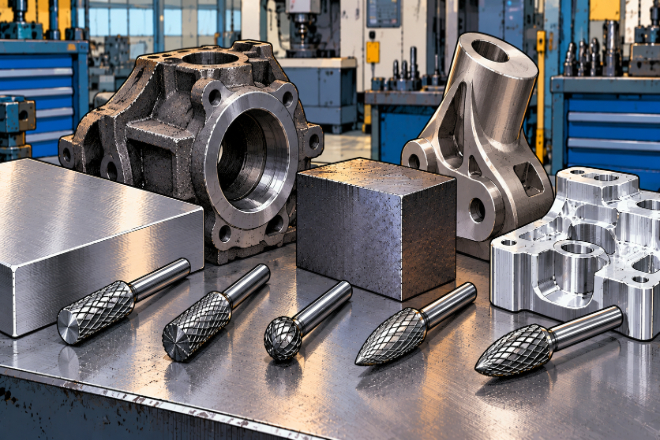
Before looking at burr shape or size, start with the workpiece.
A burr that performs well on cast iron may not be the best choice for stainless steel or aluminum. Different materials produce different chips, cutting forces, and heat.
碳化钨旋转锉 are especially useful for hard and demanding metals because their cutting edges have excellent 耐磨性.
They are commonly used on steel, stainless steel, cast iron, hardened steel, titanium alloys, and other industrial metals.
But harder is not always the whole story.
Softer metals such as aluminum can create long or sticky chips. These chips may collect between closely spaced cutting teeth and reduce cutting efficiency.
In such cases, a burr with more open flute geometry can be a better choice.
So the first buying question should not be: “Which carbide burr is the strongest?”
It should be: “Which burr is designed to cut my material efficiently?”
That small change in thinking can prevent a lot of disappointing tool tests.
2. Match the Burr Shape to the Workpiece
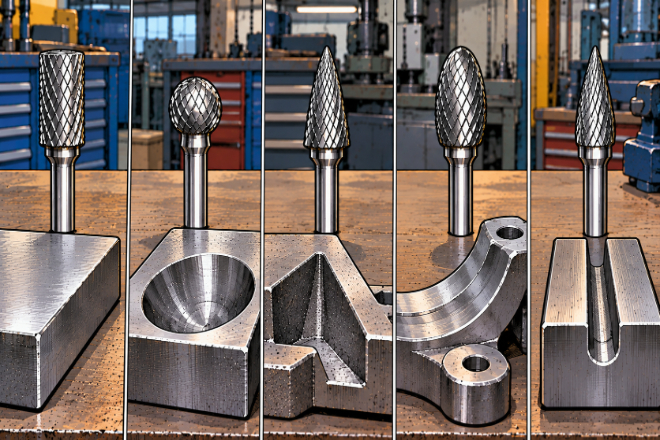
This is where carbide burr selection becomes much more visual.
Look at the area you need to machine. Is it flat? Round? Curved? Deep inside a hole? Sitting awkwardly in a corner?
There is probably a burr shape designed for it.
Cylindrical burrs work well on flat surfaces, straight edges, and internal areas where a straight profile is useful.
Ball-shaped burrs are better for rounded areas, curved surfaces, and smooth contouring.
Tree-shaped burrs are useful for reaching into angled areas and working around curved profiles.
Oval burrs can blend and shape rounded surfaces.
Flame-shaped burrs are useful when the operator needs to reach narrow or detailed areas.
Trying to use one burr shape for everything is a little like using one screwdriver for every screw in a factory. You might get away with it sometimes, but it will rarely be the fastest way to work.
The correct shape gives the cutting teeth better contact with the workpiece and makes the tool easier to control.
For production work, that can mean fewer passes and less hand finishing afterward.
3. Single Cut or Double Cut: Which Should You Choose?
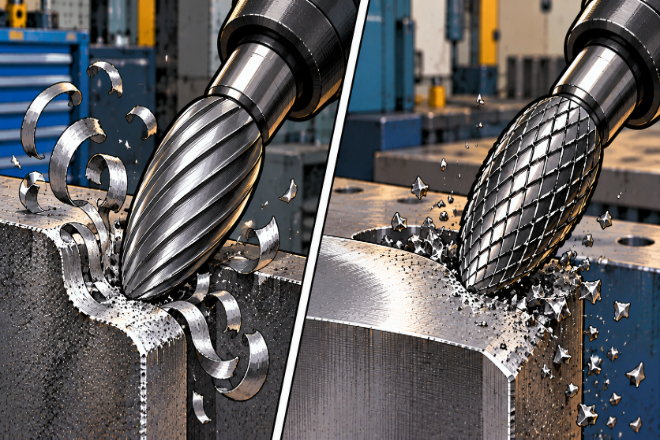
This is one of the most common questions when selecting a tungsten carbide rotary burr.
The difference is easy to see.
A single-cut burr has one main set of cutting flutes running across the carbide head. A double-cut burr adds another set crossing the first.
That small design change makes the tools behave differently.
Single-cut burrs can provide strong material removal and generally produce larger chips. They can be useful for shaping and other jobs where efficient stock removal is the main goal.
Double-cut burrs break material into smaller chips and usually give the operator greater control. They are widely used for deburring, weld cleaning, surface shaping, and general metal fabrication.
If an operator needs to remove material but still wants good control over the surface, double cut is often worth considering.
Here is a simple comparison:
4. How Much Material Do You Need to Remove?
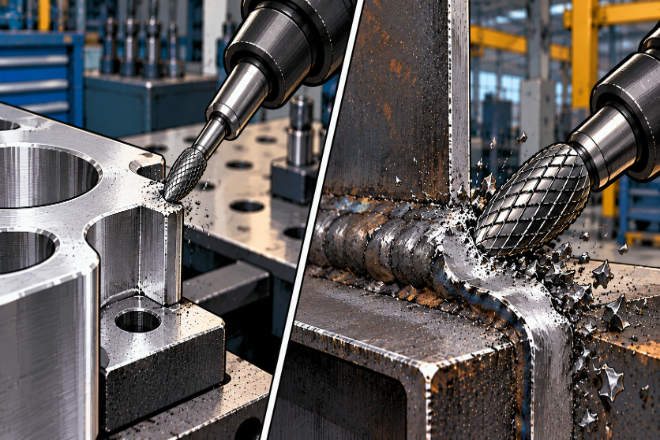
Now ask a very practical question: are you removing a tiny burr from an edge or grinding down a large weld?
Those are very different jobs.
For light deburring, the operator needs control. Removing too much metal can damage the component or change an important edge.
For heavy weld removal or reshaping, the priority may shift toward faster stock removal.
This affects the burr shape, head size, and cut style you choose.
Imagine a worker removing a small sharp edge from a precision machined component. A large aggressive burr may finish the job quickly—but perhaps a little too quickly.
One slip and the burr removes part of the finished surface.
Now put the same tool on a heavy steel weld. Suddenly aggressive cutting is useful.
This is why the “fastest” carbide burr is not automatically the most productive one.
The goal is controlled material removal. You want enough cutting action to complete the job quickly without creating extra repair or finishing work.
5. Choose the Right Burr Size for the Job
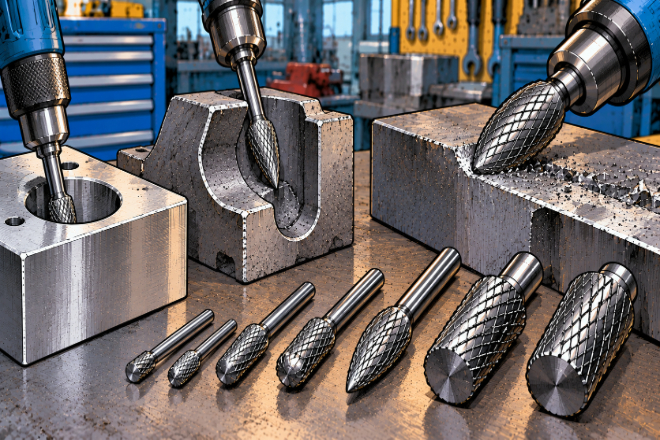
Size matters, but not in the simple “bigger is better” way.
Larger burr heads can cover more area and may be useful for removing material from broad surfaces.
Smaller burrs provide better access and control in narrow spaces, small holes, detailed profiles, and precision work.
The shank size must also match the rotary tool and collet correctly.
Using the wrong shank fit can create vibration or runout. At high rotary speeds, even a small amount of instability can affect surface quality and put extra stress on the burr.
There is another detail that operators sometimes overlook: shank extension.
Need to reach deeper into a component? Pulling a standard burr far out of the collet may seem like an easy solution.
It is not a very good one.
Excessive overhang can increase vibration and place more bending force on the shank. If deep access is part of the normal process, a burr designed with the correct reach is the better option.
Choose the burr around the actual working area—not simply around what happens to be available in the tool cabinet.
6. Don’t Ignore the Finish You Need
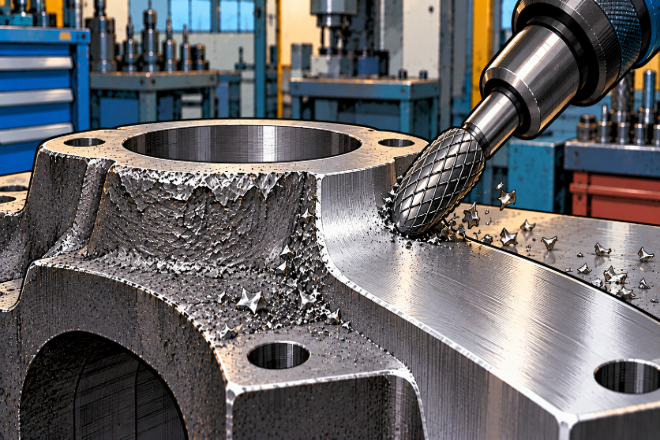
Material removal is only one part of the job.
What does the surface need to look like when the burr is finished?
If another grinding or polishing operation will follow, a rougher finish may be acceptable. If the burr is expected to leave the component close to its final condition, control becomes more important.
This is one reason double-cut burrs are popular in many fabrication shops. Their cutting pattern produces smaller chips and can offer a more controlled cutting action.
But burr selection is only part of the surface-finish story.
Speed, pressure, burr condition, machine runout, and operator movement also affect the result.
A perfectly selected carbide burr can still leave an ugly surface if it is bounced around the workpiece like a pinball.
For companies trying to reduce secondary finishing, it makes sense to test not only how quickly a burr removes metal but also what kind of surface it leaves behind.
Sometimes a slightly more controlled cut saves far more time at the next workstation.
7. Match the Burr to Your Rotary Tool
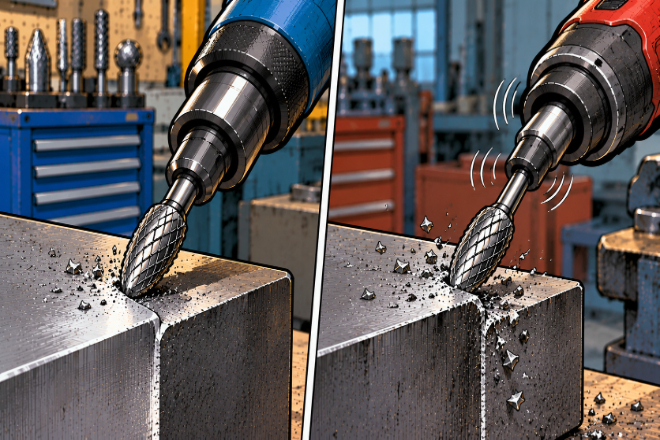
A great carbide burr on the wrong machine is still the wrong setup.
Before buying, check the rotary tool’s speed range, collet size, power, and general condition.
Burr diameter affects suitable operating speed, so the same speed should not simply be used for every burr in the tool cabinet. The workpiece material also changes the cutting conditions.
Follow the burr manufacturer’s recommended operating range for the specific tool and application.
The rotary tool should also run smoothly.
Worn bearings or poor collet condition can create runout. Instead of rotating cleanly around its center, the burr begins to move slightly off-axis.
At high speed, that small error can turn into vibration, chatter, poor finish, and shorter burr life.
Buying premium carbide burrs while ignoring a badly worn die grinder is a bit like putting new racing tires on a car with a bent wheel.
The tool system has to work together.
8. Think About Access Before Choosing the Burr
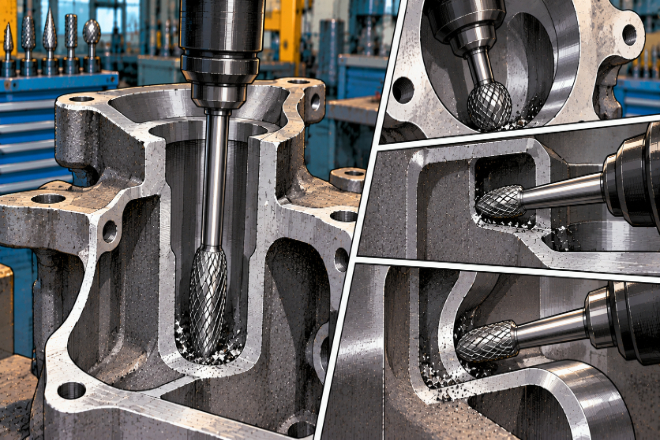
Some jobs look easy until you try to put a rotary tool into them.
A weld inside a deep steel structure, a burr inside a narrow hole, or a curved area behind another component can quickly turn access into the main problem.
This is where burr head shape and overall reach become important.
A pointed or flame-shaped burr may reach an area that a cylindrical head cannot.
A smaller head can work inside a narrow opening. Longer-reach designs can help when the cutting area sits deeper inside the component.
However, longer reach also requires more care because additional length can increase vibration.
For repeated production work, do not make operators fight the geometry of the component every day. Choose a burr that naturally reaches the cutting area.
A few minutes spent thinking about access during tool selection can save many hours on the factory floor.
9. What Mistakes Make the Right Burr Perform Badly?
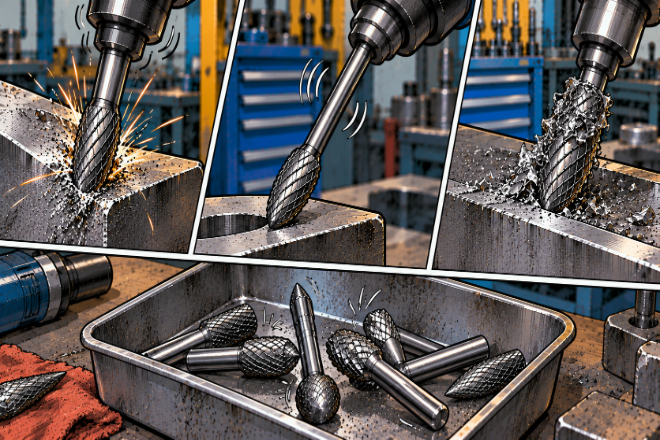
Sometimes the burr is blamed when the real problem is how it is being used.
One common mistake is excessive pressure.
A sharp carbide burr should cut with its teeth. Forcing it heavily into the workpiece can reduce speed, create heat, increase vibration, and put unnecessary stress on the carbide.
Another mistake is holding the burr in one place for too long. This can create local heat and uneven cutting.
Then there is tool loading. If chips become packed between the cutting edges, the burr cannot work efficiently.
Wrong speed is another frequent problem. Too slow can cause poor cutting and chatter. Excessive speed can create additional heat and stress.
And finally, carbide burrs should not be thrown loose into a drawer. The carbide is extremely hard, but cutting teeth can still be chipped when burr heads strike each other.
The funny thing about carbide burr performance is that buying the right burr gets you only halfway there.
Using it correctly finishes the job.
10. How Should Industrial Buyers Compare Carbide Burrs?
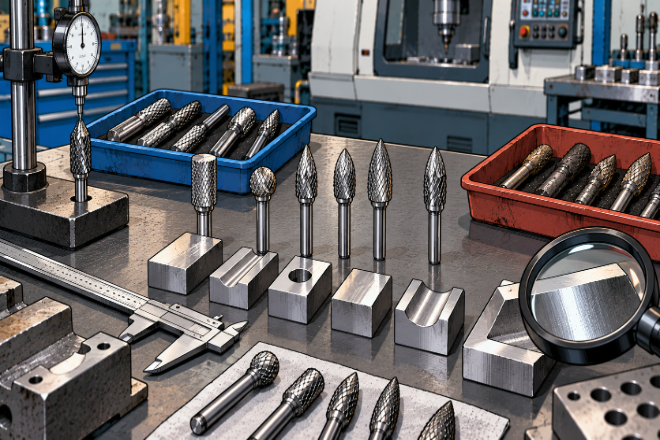
For a company buying hundreds or thousands of burrs, product selection should go beyond catalog specifications.
Run a production test.
Take several candidate burrs and use them on the same workpiece material under similar conditions. Then measure what actually matters.
How many parts can each burr complete?
How long does each component take?
How often does the burr need changing?
Does the operator experience vibration?
What does the finished surface look like?
Does another finishing process take longer with one burr than another?
This turns carbide burr purchasing into a process decision rather than a price decision.
A burr that costs 20% less is not really cheaper if operators need more time to complete each component or replace it more often.
Consistency matters as well. Industrial buyers need one production batch to perform much like the next.
Stable carbide quality, accurate flute grinding, reliable brazing, and good dimensional control all contribute to predictable results.
The cheapest box on the purchasing sheet may not create the cheapest parts on the factory floor.
11. A Simple Way to Choose the Right Carbide Burr
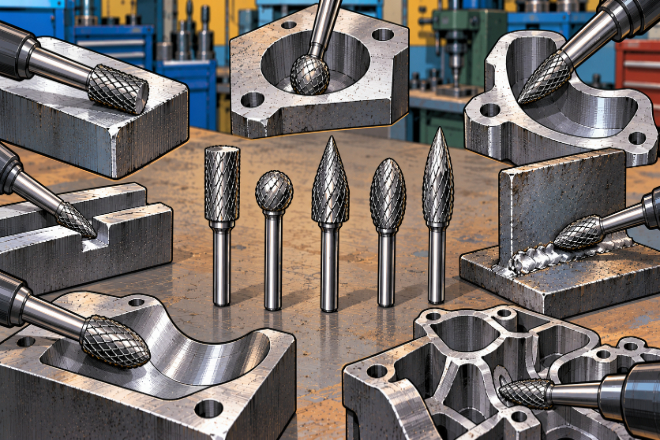
With all the shapes, sizes, and cuts available, carbide burr selection can look complicated. In practice, the decision can be narrowed down with a few questions.
Start with the material. Then look at the workpiece shape and access. Decide how much material must be removed and what finish is required.
From there, choose the cut style, burr shape, head size, and shank that fit the job.
Finally, check that your rotary tool can operate the burr correctly.
For industrial production, add one more step: test it.
Real production conditions have a habit of revealing things catalogs do not.
The best tungsten carbide burr is not simply the hardest, largest, or most expensive option.
It is the burr that completes your specific job quickly, safely, and consistently with the least total processing cost.
 English
  Español
  简体中文
简体中文  Français
  日本語
日本語  한국어
한국어  العربية
  Tiếng Việt